
The Disappearance
Gil Brewer and the Lost Collection of the Bluff Point Ruins, Part 3 of 4

continued from “The Dig, Part 2”
In the winter of 1940, Gil Brewer brought the collection home.
The iron fragments. The pottery shards. The engraved stones with their repeating face — the veiled woman, Isis or someone older, appearing again and again to him in the rubbings he had made on carbon paper pressed against cold rock. The broken platter. The granular ironwork. The pieces of a seal. Everything he had pulled from the shale and sandstone of Bluff Point over the previous two years, carried back to the house on Gibson Street in Canandaigua, carried up to the room with the typewriter and the hundreds of books.
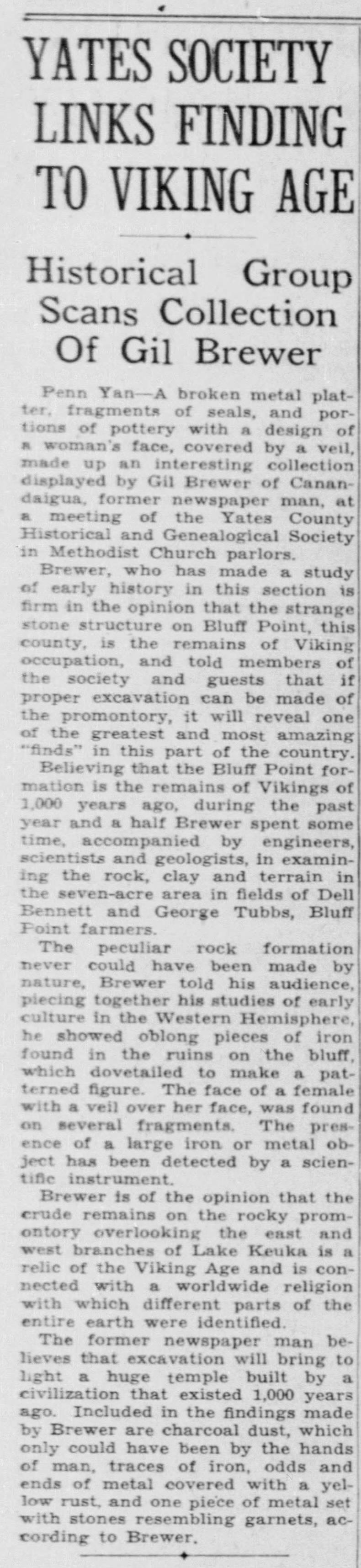
He had plans. The weather had closed the site — it was winter in the Finger Lakes, which is not a season that accommodates archaeological ambition. But spring would come. The second dig would go deeper. He had told the seventy people in the Methodist Church parlors in Penn Yan exactly what he was looking for: vaults, possibly corridors, an eight-foot strip of metal the detector had found beneath one wall. He was convinced the surface was only the beginning. He would go back.
He did not go back.
What stopped him was not one thing but many things arriving in close succession, the way losses do.
His brother Elisha had died in April of 1939, in the middle of the dig — a death that appears nowhere in the public record of the Bluff Point story, absorbed into the silence that surrounded Gil’s private life. Then Berlin Hart Wright died in November of 1940, two years after his article had set everything in motion. The old astronomer was eighty-nine years old. continued from “The Dig, Part 2”
In the winter of 1940, Gil Brewer brought the collection home.
The iron fragments. The pottery shards. The engraved stones with their repeating face — the veiled woman, Isis or someone older, appearing again and again to him in the rubbings he had made on carbon paper pressed against cold rock. The broken platter. The granular ironwork. The pieces of a seal. Everything he had pulled from the shale and sandstone of Bluff Point over the previous two years, carried back to the house on Gibson Street in Canandaigua, carried up to the room with the typewriter and the hundreds of books.
He had plans. The weather had closed the site — it was winter in the Finger Lakes, which is not a season that accommodates archaeological ambition. But spring would come. The second dig would go deeper. He had told the seventy people in the Methodist Church parlors in Penn Yan exactly what he was looking for: vaults, possibly corridors, an eight-foot strip of metal the detector had found beneath one wall. He was convinced the surface was only the beginning. He would go back.
He did not go back.
What stopped him was not one thing but many things arriving in close succession, the way losses do.
His brother Elisha had died in April of 1939, in the middle of the dig — a death that appears nowhere in the public record of the Bluff Point story, absorbed into the silence that surrounded Gil’s private life. Then Berlin Hart Wright died in November of 1940, two years after his article had set everything in motion. The old astronomer was eighty-nine years old. He had lived long enough to read the Gooding piece in the Democrat and Chronicle, long enough to know that someone had gone to the bluff with a pickaxe and found things in the dark. He died not knowing what those things actually were. None of us do.
Gil’s father, Joseph Henry Titus Brewer, died in Geneva, New York, in June of 1941. Three losses in three years — a brother, a mentor, a father — none of them recorded in the story of Bluff Point, all of them accumulating in the private life of the man who was supposed to go back in the spring.
The funding for the second dig never materialized. The professional world never came around. The geologists still said pressure ridges. And in the newsroom of the daily paper in Canandaigua, the gray-haired man at the battered typewriter kept filing copy and paying rent and feeding four children on a brass caster’s wages — because that is what the 1940 federal census lists as his occupation. Not writer. Not historian. Not archaeologist. Brass caster. Fifty hours a week. Zero recorded income from it. Other sources checked yes.
The gulf between the public Gil — the radio broadcaster, the Historical Society speaker, the man in the Democrat and Chronicle photograph holding ancient iron and daring the world to tell him he hadn’t found something — and the census Gil was as wide as a Finger Lakes winter and just as cold.
On February 16, 1942, Gil registered for the Second World War draft at the office in Canandaigua. The card records him as five feet eleven inches tall, one hundred and forty-eight pounds, light complexion, gray hair, blue eyes. Exactly as the 1937 profile had described him. He was forty-three years old. His employer was listed as the Quartermaster Corps, Seneca Ordnance Depot, Kendaia, New York.
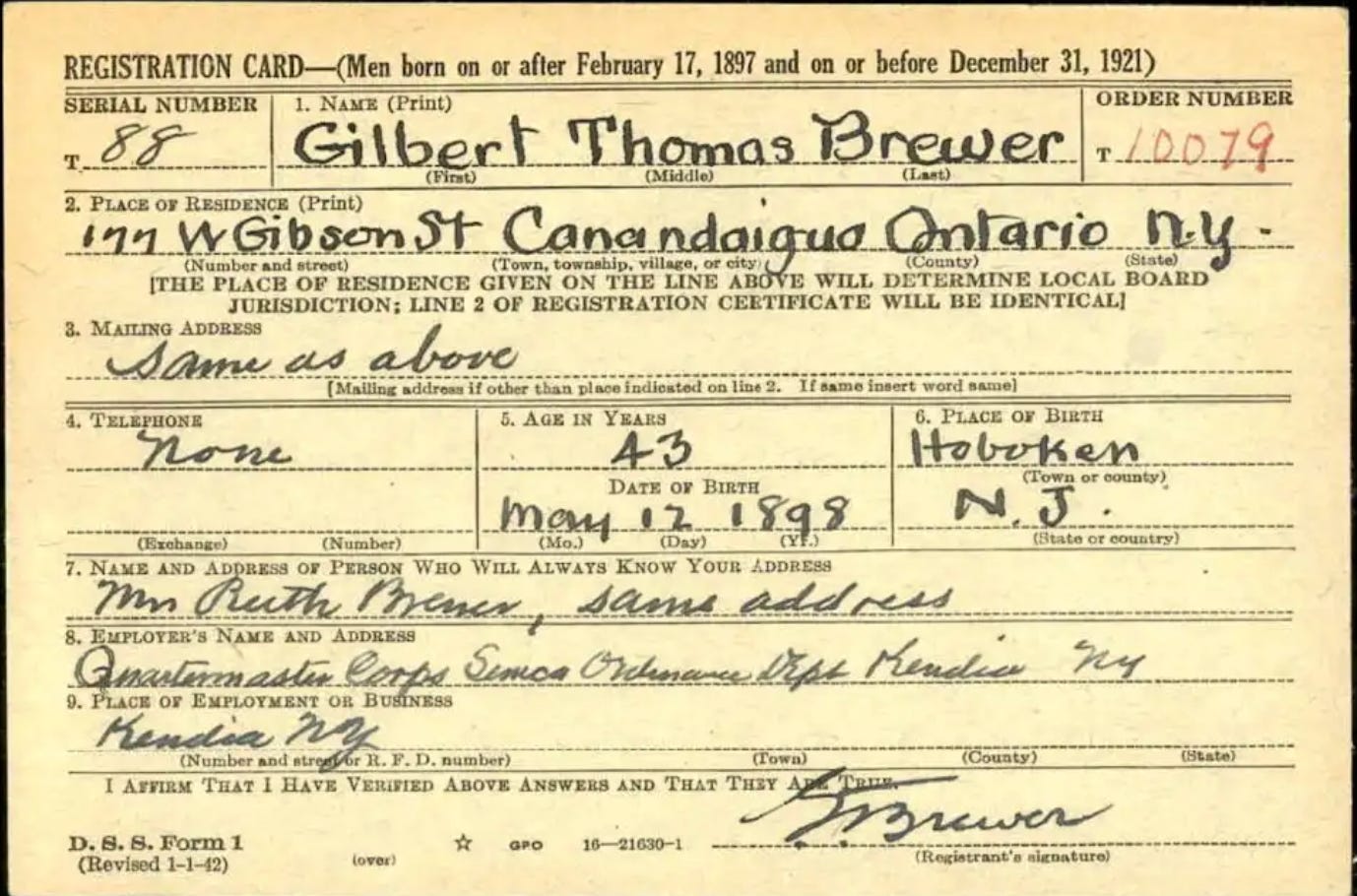
Kendaia sits on the eastern shore of Seneca Lake, roughly fifteen miles from Bluff Point as the crow flies. The ordnance depot was a massive wartime installation — hundreds of acres of bunkers and magazines carved into the same glacially shaped landscape that Gil had been excavating for evidence of ancient civilization. The man who had spent years looking for traces of a vanished people in the Finger Lakes earth was now working in a weapons depot cut into that same earth.
What he did during the war years beyond this the record does not clearly say. His daughter Nancy, writing decades later to a stranger who had asked, remembered him working at Sampson Naval Base — the enormous Navy training station on Seneca Lake that processed nearly half a million sailors during the war. Whether this was the same posting or a subsequent one, whether he saw combat or remained stateside, whether the war made things better or worse — the record is silent.
What we know is that by the end of the war, the collection was still in the house, and Gil was still in the house, and something was fraying.
It is worth pausing here, before the final act, to consider what might have been happening inside Gil Brewer during these years. Not to diagnose, and not to conclude — the record doesn’t allow either — but to look at the shape of a life and ask what it might have felt like from the inside.
Gil came home from the First World War with damaged lungs and what his daughter would later describe as shell shock. He had seen what men do to each other in industrial quantities. He had lain in a military hospital in France for six months while Europe sorted out the wreckage. And somewhere in that time, on a cot with a stack of books and lungs that were still healing, he had found something to hold onto — the idea that long before any of this, long before the trenches and the gas and the grinding machinery of modern war, other people had been here. People who built things. People who left marks in the earth that outlasted their names, their language, everything except the stones themselves.
It is not hard to see why that idea would take hold of a man in that condition. It is not hard to see why it would keep hold of him for twenty years, through the newsroom and the pulp magazines and the Rotary Club talks and the Panama expedition and the radio show. Something mythical and wondrous, as a counterweight to a life that kept trying to tether him to the earth. Something ancient and permanent in a landscape that the war had taught him was neither.
And then, in 1938, the ruins appeared — one lake over, waiting, exactly the kind of evidence he had been looking for.
For two years he dug. For two years he had something that gave his life a shape beyond the daily grind of copy and rent and four children and bills. He was a man with a mission. He was on the radio. He was standing before seventy people in a church parlor holding iron he believed was two thousand years old.
And then it stopped. The weather closed the site. The funding didn’t come. The second war arrived. His brother was gone, his father was gone, Berlin was gone. The dream of the second dig receded season by season into something he could no longer reach.
Being drafted into a second war at forty-three — a war he had not chosen and could not refuse — must have landed differently than the first. He was not sent to the front. But the uniform, the orders, the regimentation, the daily fact of being a body in a military system — for a man already carrying the weight of the first war, it is not difficult to imagine what that reactivated. Not combat trauma exactly, but something older and deeper. The original wound, reopened.
And underneath all of it, the question that may have been hardest to live with: what if he had been wrong? What if the geologists were right about the pressure ridges? What if the iron was not ancient, the pottery not significant, the veiled face of Isis just a pattern his mind had imposed on ambiguous stone? A romantic temperament — and Gil was, by every account, a romantic — does not sit easily with that question. The dream and the dreamer are too intertwined. To lose one is to lose the other.
We cannot know if this is what happened. We only know what the record shows: a man who had built his identity around a beautiful and unverifiable idea, who lost the ability to pursue it, who drank, who was in all the newspapers through 1940 and the no more after that, who spent the last two decades of his life in a VA hospital in Tennessee while his family built their lives in Florida without him.
Nancy remembered him as a fascinating man and a good dad. She learned about the rest later, from other people. Her mother sheltered the children from it as best she could.
So after the base closed, the family packed up and moved to St. Petersburg, Florida, following Gil’s transfer to Bay Pines VA Hospital. It was a fresh start of a kind — Florida in the late 1940s, the sun, the distance from the Finger Lakes winters and the bluff and the room full of things he hadn’t been able to explain.
Nancy remembered her father at Bay Pines going out each day to his job, coming home to the room with the typewriter and the hundreds of books. He still worked with the stones. She remembered him placing carbon paper against them and working with the lines they brought forth. The rubbings. Still turning the problem over, still looking for the key that would unlock the designs, still at it in private while the public story of Bluff Point sat frozen in the pages of the 1940 Chronicle-Express.
He was listed in the St. Petersburg records as a writer. He was trying, in that Florida sunlight, to reclaim the identity that the newsroom and the draft and the war and the brass casting had deferred. The reality was more modest — personnel records from the VA facility in St. Petersburg list him as a clerk typist, separating from that position on November 27, 1948.
It didn’t hold.
Sometime around late 1948 or early 1949 — the record is not precise — Gil suffered a mental breakdown.
The nature of it Nancy does not specify, and we should not speculate beyond what she tells us. What she tells us is this: he spent the remainder of his life in the VA Hospital in Murfreesboro, Tennessee.
In the Florida newspapers, Ruth Brewer began to appear in the social notices as a widow.
In November of 1950 — the same year the federal census placed Gil as an inmate in Rutherford County, Tennessee — their daughter Diana was married at First Avenue Methodist Church in St. Petersburg. The wedding announcement listed Diana as the daughter of Mrs. Gilbert Brewer. Not Mr. and Mrs. She was given in marriage by her brother David. Her father was alive in Tennessee and the announcement did not say so. The altar was decorated with palms and candelabra and standards of white gladiolus and mums. Diana wore ice blue satin. She carried lilies of the valley. Her father was not mentioned.
Two years later, in November of 1952, the Daily Messenger in Canandaigua — the paper where Gil had once worked — ran a brief item about the rising success of young Gilbert J. Brewer, the pulp novelist, formerly of Canandaigua, now making his name in St. Petersburg. The article described him as the son of Mrs. Gilbert Brewer and the late Mr. Brewer.
The late Mr. Brewer.
Gil was alive in Tennessee. He would remain alive for another fifteen years. But in the newspaper where he had once been a staff member, in a subordinate clause in his own son’s success story, he had been declared dead. It was this notice that David Robinson would find forty years later and take at face value, concluding in his 1993 Crooked Lake Review article that the Gil Brewer Collection had not survived his death in St. Petersburg, Florida, sometime prior to 1953.
Robinson could not have known otherwise. The record said what it said. It was only when I tracked down and reached out to his great-granddaughter Amanda that I learned the truth.
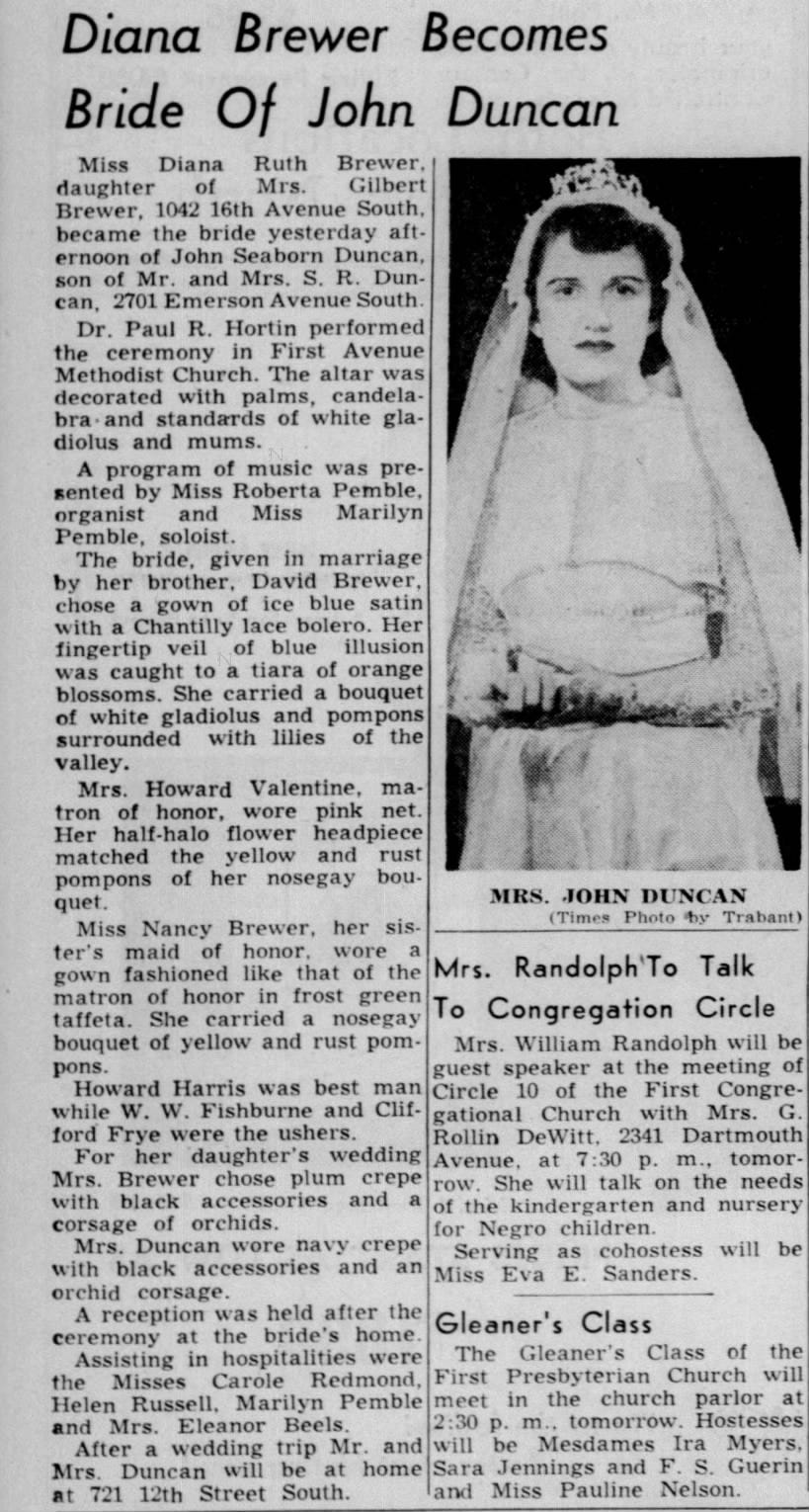
Ruth, meanwhile, remained Ruth O. Brewer. The 1950 census lists her as married, keeping house, at 1042 16th Avenue South. She never stopped being Mrs. Gilbert Brewer. She raised her children, attended her daughter’s wedding in plum crepe with black accessories and a corsage of orchids, and built a life in St. Petersburg that was stable and decent and hers. She was entitled to all of it.
She outlived her husband by four years.
Nancy, the youngest of the four children, writes about her mother with a plainness that is more affecting than any elaboration could be: “My mother was a wonderful lady who did a good job of sheltering us from those problems and giving us a good stable homelife as best she could.”
She was the last of the four children, the youngest, born in 1936. By the time she was twelve or thirteen her father was in Tennessee. She knew him mostly as the man who went out each day to his job and came home to the room with the typewriter and the books. She knew him as a fascinating man and a good dad. She learned about the drinking and the inability to provide later, from other people, filtered through her mother’s careful protection.
What she carried from her father, in the end, was a blouse made by the Kuna people of the San Blas Islands, and a wooden sword, probably used for rituals. Two objects from the Panama expedition of 1925 that had survived everything else. The rest was gone.
Gil Brewer died on July 19, 1967, in the VA Hospital in Murfreesboro, Tennessee, where he had been a patient for the better part of two decades. He was sixty-nine years old. He was buried two days later in Murfreesboro. His wife and children were in Florida. The man who had stood before seventy people in a Penn Yan church parlor in 1940 and announced he was convinced of the possibilities of opening up something great at Bluff Point died alone in a VA psychiatric facility in Tennessee, in a town that had nothing to do with the Finger Lakes or the ruins or any of it.
This correction has not appeared in any published account of the Bluff Point ruins before now.
What happened to the collection is a question the record cannot fully answer.
It did not go to a museum. It did not go to a historical society. It did not go to the University of Rochester or the Rochester Museum and Science Center or the Yates County Historical Society or any of the institutions that might have preserved and studied it. It was not donated. It was not catalogued. It simply — stopped being mentioned.
The moves may account for some of it. Canandaigua to St. Petersburg is a long way to carry boxes of iron fragments and engraved stones and carbon paper rubbings of designs that only one person knew how to read. The breakdown may account for more. An institution does not have room for a private archaeological collection. Whatever Ruth kept, she kept alone, in a house in St. Petersburg, raising four children on her own resources.
By the time Robinson was writing in 1993, the collection was already a memory of a memory — something that had existed, been seen by seventy people in a church parlor in Penn Yan in 1940, and then gone quiet. The rubbings. The iron ornament with red enamel that had retained much of its brilliance. The pottery face. Gone.
What remains, as an accounting of loss:
The Gil Brewer Collection — iron fragments, engraved stones, pottery shards, rubbings — gone before 1953, whereabouts unknown.
The Vikings West radio scripts — seventy-five episodes, 225,000 words broadcast on WHAM in 1938 and 1939 — no copies located in any archive.
The audio recordings of Vikings West — possibly one 78 rpm record in the possession of a family member, location unknown. The Rochester Radio History archive and the WHAM archive have been contacted. No recordings have been found.
The Ogden Collection at Keuka College — a separate collection of local artifacts including what was described as an iron Norwegian spear — sold by the college without authorization. Current location unknown.
The living memory of Gil’s daughters — Diana Ruth Brewer Duncan, who died in 2017, and Nancy Louise Brewer McKean, who also died in 2017, the same year as her sister. The two women who knew him as a father, who remembered the room with the typewriter and the books and the carbon paper rubbings, are gone. They took with them whatever they chose not to write down.
What remains to hold onto:
one letter from Nancy, written to a stranger in 2007. One email exchange with a great-granddaughter who almost didn’t open the message because she had never heard the name Gilbert Brewer.
A draft card. A census record listing his occupation as brass caster.
Photographs of white iron and of a slender gray-haired daring the world to tell him he hadn’t found something.
And somewhere: a blouse made by the Kuna people of the San Blas Islands, and a wooden sword.
The excavation pits Gil’s team dug in 1938 and 1939 were still visible from Skyline Drive in 1980, half-hidden in a thicket of deer brush and poplar. A small curved wall of laid-up stone, eight to twelve inches high, oriented to the southwest, was also still standing — one of the last physical remnants of whatever the dig uncovered.
By now, even those are gone.
But in the 1960s, when telephone workers were laying underground lines along the roads of Bluff Point, the line-laying machine kept hitting rocks. The workers had to dig by hand. And in doing so they exposed cross-sections of laid-up, slanting stones — matching Wright’s description of the graded ways exactly.
Gil Brewer spent two years trying to find out what they meant. He found things he couldn’t explain and lost the ability to explain them. He disappeared, in stages, into a life that had no room for the question.
But the question is still in the ground.
Part Four: The Keepers (coming next week)
This is part three of a four-part series on Gilbert Brewer and the Bluff Point Ruins. Read the full series here.
For full bibliography, historical documents, investigative research, and timeline of Bluff Point Ruins, visit our Research Portal.
Bibliography
Primary Sources: Family Documents and Correspondence
McKean, Nancy [née Brewer, daughter of Gilbert T. Brewer]. Letter to George Tuttle. June 19, 2007. Personal archive of Nina Alvarez, shared with permission of Amanda Johnson.
Wilson, David Laurence. Email to Mrs. Duncan [Nancy McKean, née Brewer]. June 7, 2007. Forwarded correspondence in the personal archive of Nina Alvarez, shared with permission of Amanda Johnson.
Johnson, Amanda [great-granddaughter of Gilbert T. Brewer]. Email correspondence with Nina Alvarez. July 14–19, 2022. Personal archive of Nina Alvarez, shared with permission of Amanda Johnson.
Primary Sources: Military and Vital Records
Brewer, Gilbert Thomas. World War II Draft Registration Card. Registration Date: February 16, 1942. Registration Place: Canandaigua, New York. National Archives at St. Louis, Missouri. Record Group: Records of the Selective Service System, 147. Via Ancestry.com, U.S., World War II Draft Cards Young Men, 1940–1947.
Brewer, Gilbert Thomas. United States Federal Census, 1940. Canandaigua, Ontario County, New York. Sheet 4A, Household 93. Via Ancestry.com.
Brewer, Gilbert T. United States Federal Census, 1950. Rutherford County, Tennessee. Dwelling Number 231. Veterans Administration Hospital #5137. Listed as inmate, age 51, married, born New Jersey. Record Group 29, Records of the Bureau of the Census, 1790–2007. Seventeenth Census of the United States. Via Ancestry.com.
Brewer, Ruth O. United States Federal Census, 1950. St. Petersburg, Pinellas County, Florida. House 1042, Sixteenth Avenue South. Via Ancestry.com. [Confirms Ruth Brewer remained at the family address, listed as married, with three children, while Gilbert T. Brewer was simultaneously listed as an inmate in Rutherford County, Tennessee.]
Brewer, Gilbert Thomas. Ancestry.com compiled profile, incorporating U.S. Federal Census records 1900–1950, New York State vital records, U.S. Army enlistment and discharge records, passenger arrival records, and death records. Tree ID 178873931. Ancestry.com Operations, Inc.
Brewer, Gilbert Thomas. Death Record. July 19, 1967. Murfreesboro, Rutherford County, Tennessee. Via Ancestry.com.
Brewer, Diana Ruth and John Seaborn Duncan. Marriage Record. November 17, 1950. Pinellas County, Florida. Florida, U.S., County Marriage Records, 1823–1982. State Archive, Tallahassee and Clerk of Courts, County Marriages, 1949–1951. Via Ancestry.com.
Primary Sources: Newspaper Articles
“Diana Brewer Becomes Bride of John Duncan.” Tampa Bay Times (St. Petersburg, Florida), November 26, 1950, p. 69. [Wedding announcement listing Diana as daughter of Mrs. Gilbert Brewer only, with no mention of her father. Her brother David gave her away in her father’s absence.]
“Ex-Resident is Successful Author.” The Daily Messenger (Canandaigua, New York), November 3, 1952. [Refers to Gilbert T. Brewer as “the late Mr. Brewer” while he was alive in the VA Hospital in Murfreesboro, Tennessee. The reference to Ruth as “Mrs. Gilbert Taber” appears to be a typographical error — the 1950 federal census confirms she remained Ruth O. Brewer. This article is the source of David Robinson’s erroneous death date in his 1993 Crooked Lake Review article.]
Gooding, E.H. “Penn Yan Ruins Hint Old American Empire: Archeologist Thinks Early Race Had Greek Influence.” Democrat and Chronicle (Rochester, New York), October 1, 1939. [The photograph of Gil holding white iron pieces appears in this article.]
“Gil Brewer Describes Excavation on Bluff Point.” Chronicle-Express (Penn Yan, New York), March 14, 1940. [Account of the Historical Society talk attended by seventy people, at which Gil announced plans for a second dig.]
“Society Links Finding to Viking Age.” Democrat and Chronicle (Rochester, New York), March 3, 1940.
“Berlin Hart Wright, Astronomer, Dies.” The New York Times, November 28, 1940. [Death of the man whose 1938 article set the Bluff Point excavation in motion.]
“Concert By Male Chorus Given at Veterans Center.” [Personnel Changes.] St. Petersburg Times (St. Petersburg, Florida), November 27, 1948. [Lists Gilbert T. Brewer under Separations as a clerk typist at the Veterans Center, St. Petersburg, Florida. Establishes his employment and separation date immediately prior to his mental breakdown.]
Secondary Sources
Robinson, David D. “More on the Bluff Point Ruin.” Crooked Lake Review. Originally published November 1993; follow-up article circa 1995–1996. [Contains the erroneous statement that Gil Brewer died in St. Petersburg, Florida, sometime prior to 1953, based on the 1952 Daily Messenger notice. Corrected by the author’s research for this series.]
Wright, Christopher A. “Bluff Point Stoneworks.” Paper presented to the Yates County Historical Society, Penn Yan, New York, April 1980. [Notes excavation pits still visible from Skyline Drive and a small curved wall still standing as of 1980.]
Kelley, David B., in association with Virginia Gibbs, Yates County Historian. “Pre-Colonial Earthen and Stone Ruins in Yates County, New York.” Penn Yan, New York, January 1, 1988. [Contains the telephone workers account — workers laying underground lines in the 1960s exposed cross-sections of laid-up slanting stones matching Wright’s 1880 description of the graded ways, witnessed by a landowner who had never read the survey.]
Archive Contacts
Rochester Radio History Archive. Contacted by Nina Alvarez, 2022–2024. No recordings of Vikings West located.
WHAM Radio Archive, Rochester, New York. Contacted by Nina Alvarez, 2022–2024. No recordings of Vikings West located.
Rochester Museum and Science Center Archive, Rochester, New York. Contacted by Nina Alvarez, 2022. No response received regarding possible Brewer materials.
He died not knowing what those things actually were. None of us do.
Gil’s father, Joseph Henry Titus Brewer, died in Geneva, New York, in June of 1941. Three losses in three years — a brother, a mentor, a father — none of them recorded in the story of Bluff Point, all of them accumulating in the private life of the man who was supposed to go back in the spring.
The funding for the second dig never materialized. The professional world never came around. The geologists still said pressure ridges. And in the newsroom of the daily paper in Canandaigua, the gray-haired man at the battered typewriter kept filing copy and paying rent and feeding four children on a brass caster’s wages — because that is what the 1940 federal census lists as his occupation. Not writer. Not historian. Not archaeologist. Brass caster. Fifty hours a week. Zero recorded income from it. Other sources checked yes.
The gulf between the public Gil — the radio broadcaster, the Historical Society speaker, the man in the Democrat and Chronicle photograph holding ancient iron and daring the world to tell him he hadn’t found something — and the census Gil was as wide as a Finger Lakes winter and just as cold.
On February 16, 1942, Gil registered for the Second World War draft at the office in Canandaigua. The card records him as five feet eleven inches tall, one hundred and forty-eight pounds, light complexion, gray hair, blue eyes. Exactly as the 1937 profile had described him. He was forty-three years old. His employer was listed as the Quartermaster Corps, Seneca Ordnance Depot, Kendaia, New York.
Kendaia sits on the eastern shore of Seneca Lake, roughly fifteen miles from Bluff Point as the crow flies. The ordnance depot was a massive wartime installation — hundreds of acres of bunkers and magazines carved into the same glacially shaped landscape that Gil had been excavating for evidence of ancient civilization. The man who had spent years looking for traces of a vanished people in the Finger Lakes earth was now working in a weapons depot cut into that same earth.
What he did during the war years beyond this the record does not clearly say. His daughter Nancy, writing decades later to a stranger who had asked, remembered him working at Sampson Naval Base — the enormous Navy training station on Seneca Lake that processed nearly half a million sailors during the war. Whether this was the same posting or a subsequent one, whether he saw combat or remained stateside, whether the war made things better or worse — the record is silent.
What we know is that by the end of the war, the collection was still in the house, and Gil was still in the house, and something was fraying.
It is worth pausing here, before the final act, to consider what might have been happening inside Gil Brewer during these years. Not to diagnose, and not to conclude — the record doesn’t allow either — but to look at the shape of a life and ask what it might have felt like from the inside.
Gil came home from the First World War with damaged lungs and what his daughter would later describe as shell shock. He had seen what men do to each other in industrial quantities. He had lain in a military hospital in France for six months while Europe sorted out the wreckage. And somewhere in that time, on a cot with a stack of books and lungs that were still healing, he had found something to hold onto — the idea that long before any of this, long before the trenches and the gas and the grinding machinery of modern war, other people had been here. People who built things. People who left marks in the earth that outlasted their names, their language, everything except the stones themselves.
It is not hard to see why that idea would take hold of a man in that condition. It is not hard to see why it would keep hold of him for twenty years, through the newsroom and the pulp magazines and the Rotary Club talks and the Panama expedition and the radio show. Something mythical and wondrous, as a counterweight to a life that kept trying to tether him to the earth. Something ancient and permanent in a landscape that the war had taught him was neither.
And then, in 1938, the ruins appeared — one lake over, waiting, exactly the kind of evidence he had been looking for.
For two years he dug. For two years he had something that gave his life a shape beyond the daily grind of copy and rent and four children and bills. He was a man with a mission. He was on the radio. He was standing before seventy people in a church parlor holding iron he believed was two thousand years old.
And then it stopped. The weather closed the site. The funding didn’t come. The second war arrived. His brother was gone, his father was gone, Berlin was gone. The dream of the second dig receded season by season into something he could no longer reach.
Being drafted into a second war at forty-three — a war he had not chosen and could not refuse — must have landed differently than the first. He was not sent to the front. But the uniform, the orders, the regimentation, the daily fact of being a body in a military system — for a man already carrying the weight of the first war, it is not difficult to imagine what that reactivated. Not combat trauma exactly, but something older and deeper. The original wound, reopened.
And underneath all of it, the question that may have been hardest to live with: what if he had been wrong? What if the geologists were right about the pressure ridges? What if the iron was not ancient, the pottery not significant, the veiled face of Isis just a pattern his mind had imposed on ambiguous stone? A romantic temperament — and Gil was, by every account, a romantic — does not sit easily with that question. The dream and the dreamer are too intertwined. To lose one is to lose the other.
We cannot know if this is what happened. We only know what the record shows: a man who had built his identity around a beautiful and unverifiable idea, who lost the ability to pursue it, who drank, who was in all the newspapers in 1939 and the no more after that, who spent the last two decades of his life in a VA hospital in Tennessee while his family built their lives in Florida without him.
Nancy remembered him as a fascinating man and a good dad. She learned about the rest later, from other people. Her mother sheltered the children from it as best she could.
So after the base closed, the family packed up and moved to St. Petersburg, Florida, following Gil’s transfer to Bay Pines VA Hospital. It was a fresh start of a kind — Florida in the late 1940s, the sun, the distance from the Finger Lakes winters and the bluff and the room full of things he hadn’t been able to explain.
Nancy remembered her father at Bay Pines going out each day to his job, coming home to the room with the typewriter and the hundreds of books. He still worked with the stones. She remembered him placing carbon paper against them and working with the lines they brought forth. The rubbings. Still turning the problem over, still looking for the key that would unlock the designs, still at it in private while the public story of Bluff Point sat frozen in the pages of the 1940 Chronicle-Express.
He was listed in the St. Petersburg records as a writer. He was trying, in that Florida sunlight, to reclaim the identity that the newsroom and the draft and the war and the brass casting had deferred. The reality was more modest — personnel records from the VA facility in St. Petersburg list him as a clerk typist, separating from that position on November 27, 1948.
It didn’t hold.
Sometime around late 1948 or early 1949 — the record is not precise — Gil suffered a mental breakdown.
The nature of it Nancy does not specify, and we should not speculate beyond what she tells us. What she tells us is this: he spent the remainder of his life in the VA Hospital in Murfreesboro, Tennessee.
In the Florida newspapers, Ruth Brewer began to appear in the social notices as a widow.
In November of 1950 — the same year the federal census placed Gil as an inmate in Rutherford County, Tennessee — their daughter Diana was married at First Avenue Methodist Church in St. Petersburg. The wedding announcement listed Diana as the daughter of Mrs. Gilbert Brewer. Not Mr. and Mrs. She was given in marriage by her brother David. Her father was alive in Tennessee and the announcement did not say so. The altar was decorated with palms and candelabra and standards of white gladiolus and mums. Diana wore ice blue satin. She carried lilies of the valley. Her father was not mentioned.
Two years later, in November of 1952, the Daily Messenger in Canandaigua — the paper where Gil had once worked — ran a brief item about the rising success of young Gilbert J. Brewer, the pulp novelist, formerly of Canandaigua, now making his name in St. Petersburg. The article described him as the son of Mrs. Gilbert Brewer and the late Mr. Brewer.
The late Mr. Brewer.
Gil was alive in Tennessee. He would remain alive for another fifteen years. But in the newspaper where he had once been a staff member, in a subordinate clause in his own son’s success story, he had been declared dead. It was this notice that David Robinson would find forty years later and take at face value, concluding in his 1993 Crooked Lake Review article that the Gil Brewer Collection had not survived his death in St. Petersburg, Florida, sometime prior to 1953.
Robinson could not have known otherwise. The record said what it said. It was only when I tracked down and reached out to his great-granddaughter Amanda that I learned the truth.
Ruth, meanwhile, remained Ruth O. Brewer. The 1950 census lists her as married, keeping house, at 1042 16th Avenue South. She never stopped being Mrs. Gilbert Brewer. She raised her children, attended her daughter’s wedding in plum crepe with black accessories and a corsage of orchids, and built a life in St. Petersburg that was stable and decent and hers. She was entitled to all of it.
She outlived her husband by four years.
Nancy, the youngest of the four children, writes about her mother with a plainness that is more affecting than any elaboration could be: “My mother was a wonderful lady who did a good job of sheltering us from those problems and giving us a good stable homelife as best she could.”
She was the last of the four children, the youngest, born in 1936. By the time she was twelve or thirteen her father was in Tennessee. She knew him mostly as the man who went out each day to his job and came home to the room with the typewriter and the books. She knew him as a fascinating man and a good dad. She learned about the drinking and the inability to provide later, from other people, filtered through her mother’s careful protection.
What she carried from her father, in the end, was a blouse made by the Kuna people of the San Blas Islands, and a wooden sword, probably used for rituals. Two objects from the Panama expedition of 1925 that had survived everything else. The rest was gone.
Gil Brewer died on July 19, 1967, in the VA Hospital in Murfreesboro, Tennessee, where he had been a patient for the better part of two decades. He was sixty-nine years old. He was buried two days later in Murfreesboro. His wife and children were in Florida. The man who had stood before seventy people in a Penn Yan church parlor in 1940 and announced he was convinced of the possibilities of opening up something great at Bluff Point died alone in a VA psychiatric facility in Tennessee, in a town that had nothing to do with the Finger Lakes or the ruins or any of it.
This correction has not appeared in any published account of the Bluff Point ruins before now.
What happened to the collection is a question the record cannot fully answer.
It did not go to a museum. It did not go to a historical society. It did not go to the University of Rochester or the Rochester Museum and Science Center or the Yates County Historical Society or any of the institutions that might have preserved and studied it. It was not donated. It was not catalogued. It simply — stopped being mentioned.
The moves may account for some of it. Canandaigua to St. Petersburg is a long way to carry boxes of iron fragments and engraved stones and carbon paper rubbings of designs that only one person knew how to read. The breakdown may account for more. An institution does not have room for a private archaeological collection. Whatever Ruth kept, she kept alone, in a house in St. Petersburg, raising four children on her own resources.
By the time Robinson was writing in 1993, the collection was already a memory of a memory — something that had existed, been seen by seventy people in a church parlor in Penn Yan in 1940, and then gone quiet. The rubbings. The iron ornament with red enamel that had retained much of its brilliance. The pottery face. Gone.
What remains, as an accounting of loss:
The Gil Brewer Collection — iron fragments, engraved stones, pottery shards, rubbings — gone before 1953, whereabouts unknown.
The Vikings West radio scripts — seventy-five episodes, 225,000 words broadcast on WHAM in 1938 and 1939 — no copies located in any archive.
The audio recordings of Vikings West — possibly one 78 rpm record in the possession of a family member, location unknown. The Rochester Radio History archive and the WHAM archive have been contacted. No recordings have been found.
The Ogden Collection at Keuka College — a separate collection of local artifacts including what was described as an iron Norwegian spear — sold by the college without authorization. Current location unknown.
The living memory of Gil's daughters — Diana Ruth Brewer Duncan, who died in 2017, and Nancy Louise Brewer McKean, who also died in 2017, the same year as her sister. The two women who knew him as a father, who remembered the room with the typewriter and the books and the carbon paper rubbings, are gone. They took with them whatever they chose not to write down.
What remains to hold onto:
one letter from Nancy, written to a stranger in 2007. One email exchange with a great-granddaughter who almost didn’t open the message because she had never heard the name Gilbert Brewer.
A draft card. A census record listing his occupation as brass caster.
Photographs of a slender gray-haired man and pieces of white iron and daring the world to tell him he hadn’t found something.
And somewhere: a blouse made by the Kuna people of the San Blas Islands, and a wooden sword.
The excavation pits Gil’s team dug in 1938 and 1939 were still visible from Skyline Drive in 1980, half-hidden in a thicket of deer brush and poplar. A small curved wall of laid-up stone, eight to twelve inches high, oriented to the southwest, was also still standing — one of the last physical remnants of whatever the dig uncovered.
By now, even those are gone.
But in the 1960s, when telephone workers were laying underground lines along the roads of Bluff Point, the line-laying machine kept hitting rocks. The workers had to dig by hand. And in doing so they exposed cross-sections of laid-up, slanting stones — matching Wright’s description of the graded ways exactly.
Gil Brewer spent two years trying to find out what they meant. He found things he couldn’t explain and lost the ability to explain them. He disappeared, in stages, into a life that had no room for the question.
But the question is still in the ground.
Part Four: The Keepers (coming next week)
This is part three of a four-part series on Gilbert Brewer and the Bluff Point Ruins. Read the full series here.
For full bibliography, historical documents, investigative research, and timeline of Bluff Point Ruins, visit our Research Portal.
Bibliography
Primary Sources: Family Documents and Correspondence
McKean, Nancy [née Brewer, daughter of Gilbert T. Brewer]. Letter to George Tuttle. June 19, 2007. Personal archive of Nina Alvarez, shared with permission of Amanda Johnson.
Wilson, David Laurence. Email to Mrs. Duncan [Nancy McKean, née Brewer]. June 7, 2007. Forwarded correspondence in the personal archive of Nina Alvarez, shared with permission of Amanda Johnson.
Johnson, Amanda [great-granddaughter of Gilbert T. Brewer]. Email correspondence with Nina Alvarez. July 14–19, 2022. Personal archive of Nina Alvarez, shared with permission of Amanda Johnson.
Primary Sources: Military and Vital Records
Brewer, Gilbert Thomas. World War II Draft Registration Card. Registration Date: February 16, 1942. Registration Place: Canandaigua, New York. National Archives at St. Louis, Missouri. Record Group: Records of the Selective Service System, 147. Via Ancestry.com, U.S., World War II Draft Cards Young Men, 1940–1947.
Brewer, Gilbert Thomas. United States Federal Census, 1940. Canandaigua, Ontario County, New York. Sheet 4A, Household 93. Via Ancestry.com.
Brewer, Gilbert T. United States Federal Census, 1950. Rutherford County, Tennessee. Dwelling Number 231. Veterans Administration Hospital #5137. Listed as inmate, age 51, married, born New Jersey. Record Group 29, Records of the Bureau of the Census, 1790–2007. Seventeenth Census of the United States. Via Ancestry.com.
Brewer, Ruth O. United States Federal Census, 1950. St. Petersburg, Pinellas County, Florida. House 1042, Sixteenth Avenue South. Via Ancestry.com. [Confirms Ruth Brewer remained at the family address, listed as married, with three children, while Gilbert T. Brewer was simultaneously listed as an inmate in Rutherford County, Tennessee.]
Brewer, Gilbert Thomas. United States Federal Census, 1950. Rutherford County, Tennessee. [Listed as inmate.] Via Ancestry.com.
Brewer, Gilbert Thomas. Ancestry.com compiled profile, incorporating U.S. Federal Census records 1900–1950, New York State vital records, U.S. Army enlistment and discharge records, passenger arrival records, and death records. Tree ID 178873931. Ancestry.com Operations, Inc.
Brewer, Gilbert Thomas. Death Record. July 19, 1967. Murfreesboro, Rutherford County, Tennessee. Via Ancestry.com.
Brewer, Diana Ruth and John Seaborn Duncan. Marriage Record. November 17, 1950. Pinellas County, Florida. Florida, U.S., County Marriage Records, 1823–1982. State Archive, Tallahassee and Clerk of Courts, County Marriages, 1949–1951. Via Ancestry.com.
Primary Sources: Newspaper Articles
“Diana Brewer Becomes Bride of John Duncan.” Tampa Bay Times (St. Petersburg, Florida), November 26, 1950, p. 69. [Wedding announcement listing Diana as daughter of Mrs. Gilbert Brewer only, with no mention of her father. Her brother David gave her away in her father’s absence.]
“Ex-Resident is Successful Author.” The Daily Messenger (Canandaigua, New York), November 3, 1952. [Refers to Gilbert T. Brewer as “the late Mr. Brewer” while he was alive in the VA Hospital in Murfreesboro, Tennessee. The reference to Ruth as “Mrs. Gilbert Taber” appears to be a typographical error — the 1950 federal census confirms she remained Ruth O. Brewer. This article is the source of David Robinson’s erroneous death date in his 1993 Crooked Lake Review article.]
Gooding, E.H. “Penn Yan Ruins Hint Old American Empire: Archeologist Thinks Early Race Had Greek Influence.” Democrat and Chronicle (Rochester, New York), October 1, 1939. [The photograph of Gil holding white iron pieces appears in this article.]
“Gil Brewer Describes Excavation on Bluff Point.” Chronicle-Express (Penn Yan, New York), March 14, 1940. [Account of the Historical Society talk attended by seventy people, at which Gil announced plans for a second dig.]
“Society Links Finding to Viking Age.” Democrat and Chronicle (Rochester, New York), March 3, 1940.
“Berlin Hart Wright, Astronomer, Dies.” The New York Times, November 28, 1940. [Death of the man whose 1938 article set the Bluff Point excavation in motion.]
"Concert By Male Chorus Given at Veterans Center." [Personnel Changes.] St. Petersburg Times (St. Petersburg, Florida), November 27, 1948. [Lists Gilbert T. Brewer under Separations as a clerk typist at the Veterans Center, St. Petersburg, Florida. Establishes his employment and separation date immediately prior to his mental breakdown.]
Secondary Sources
Robinson, David D. “More on the Bluff Point Ruin.” Crooked Lake Review. Originally published November 1993; follow-up article circa 1995–1996. [Contains the erroneous statement that Gil Brewer died in St. Petersburg, Florida, sometime prior to 1953, based on the 1952 Daily Messenger notice. Corrected by the author’s research for this series.]
Wright, Christopher A. “Bluff Point Stoneworks.” Paper presented to the Yates County Historical Society, Penn Yan, New York, April 1980. [Notes excavation pits still visible from Skyline Drive and a small curved wall still standing as of 1980.]
Kelley, David B., in association with Virginia Gibbs, Yates County Historian. “Pre-Colonial Earthen and Stone Ruins in Yates County, New York.” Penn Yan, New York, January 1, 1988. [Contains the telephone workers account — workers laying underground lines in the 1960s exposed cross-sections of laid-up slanting stones matching Wright’s 1880 description of the graded ways, witnessed by a landowner who had never read the survey.]
Archive Contacts
Rochester Radio History Archive. Contacted by Nina Alvarez, 2022–2024. No recordings of Vikings West located.
WHAM Radio Archive, Rochester, New York. Contacted by Nina Alvarez, 2022–2024. No recordings of Vikings West located.
Rochester Museum and Science Center Archive, Rochester, New York. Contacted by Nina Alvarez, 2022. No response received regarding possible Brewer materials.